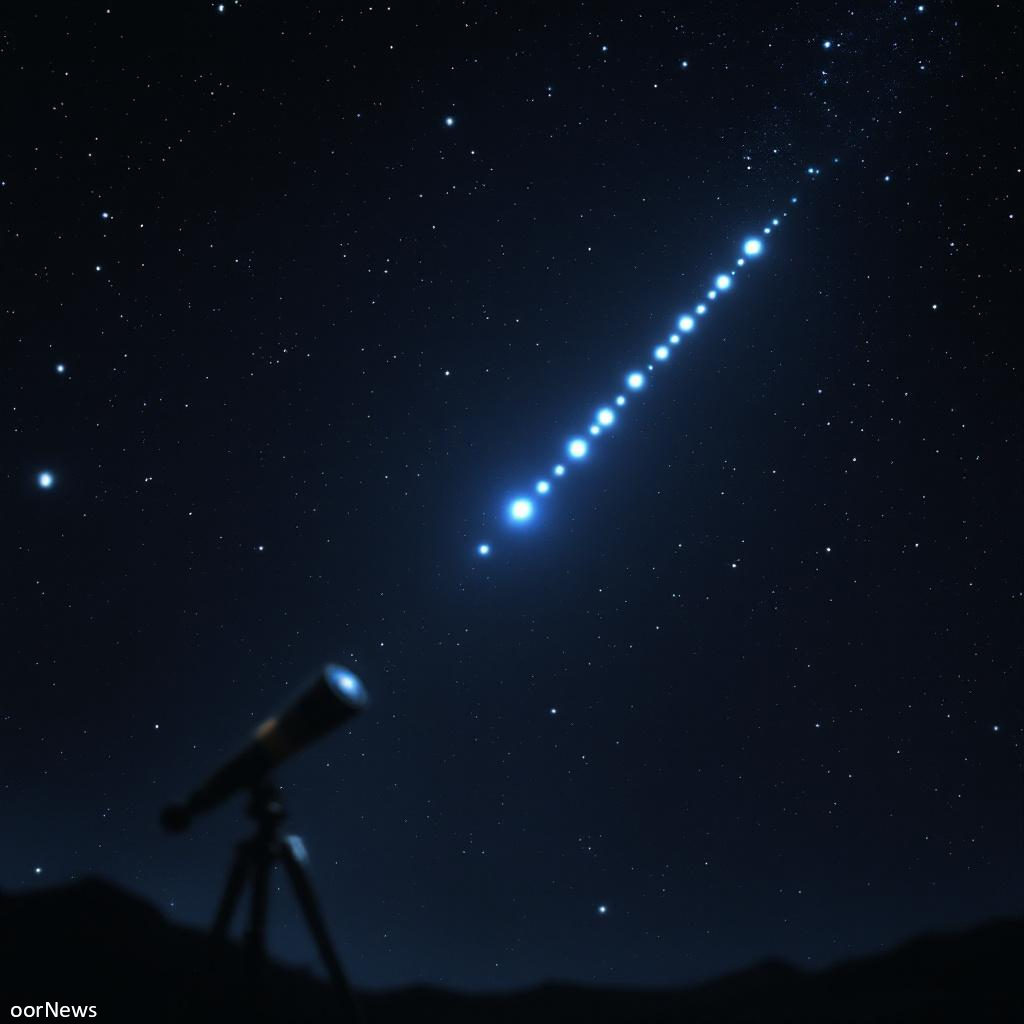
A recent scientific study, currently under peer review, suggests that objects resembling non-terrestrial artifacts may have been orbiting Earth decades before humans launched their first satellite. The research, led by Dr. Beatriz Villarroel of Stockholm University, examines old astronomical photographs taken during the 1950s and raises the intriguing possibility that reflective, “mirror-like” objects could have been observed in Earth’s vicinity.
The study, titled “Aligned, multiple-transient events in the First Palomar Sky Survey,” analyses nearly 300,000 temporary flashes of light recorded on photographic plates from the First Palomar Sky Survey (POSS-I), which documented the night sky between 1949 and 1958. Transients are brief light events that appear and vanish quickly; the research team looked for specific patterns that could indicate artificial objects.
Dr. Villarroel explained the focus of the investigation: “are the transients real, or plate defects?” Her team’s findings suggest these flashes are unlikely to be errors or known astronomical phenomena. Instead, they may result from sunlight reflecting off flat, shiny surfaces—possibly artificial—tumbling through space.
A key discovery is the pattern of multiple flashes aligned in straight lines on a single photographic plate within a long exposure. Such alignments are improbable to occur by chance from natural sources, implying a potential link to sunlight glinting off flat, highly reflective surfaces. The statistical analysis shows that one particular set of five points has a significance of about 3.9 sigma, meaning there’s roughly a 1 in 10,000 chance this happened randomly. Moreover, the researchers conducted a “shadow test,” confirming that these transient events significantly decline when the objects would pass into Earth’s shadow—a sign that sunlight reflection is a probable cause.
Adding to the mystery, some of the most significant candidate events correlate with well-documented UFO sightings. One example occurred on July 27, 1952, aligning with the second weekend of a famous UFO panic in Washington D.C., where numerous radar and pilot reports flooded the media. Another event relates closely to a major UFO wave in 1954. The researchers acknowledge that these temporal overlaps could be coincidental but emphasize their potential importance for further study.
The possibility of non-terrestrial objects orbiting Earth before the space race challenges conventional understanding. The authors suggest that there may have been a population of artifacts reflecting sunlight, perhaps in geostationary orbits, functioning as technosignatures—physical signs of intelligent activity. If confirmed, these findings could dramatically alter humanity’s view of its place in the universe and suggest that Earth may have been visited or even monitored long before the modern age.
While the research remains preliminary and subject to peer review, its implications are profound. It opens new pathways for investigating ancient observational data for signs of extraterrestrial technology. As Dr. Villarroel notes, “these findings may represent a new class of astronomical phenomena or the first hints of artificial activity near our planet.” In essence, the faint echoes captured on old glass plates might be telling us a story that redefines human history and our cosmic neighbors.