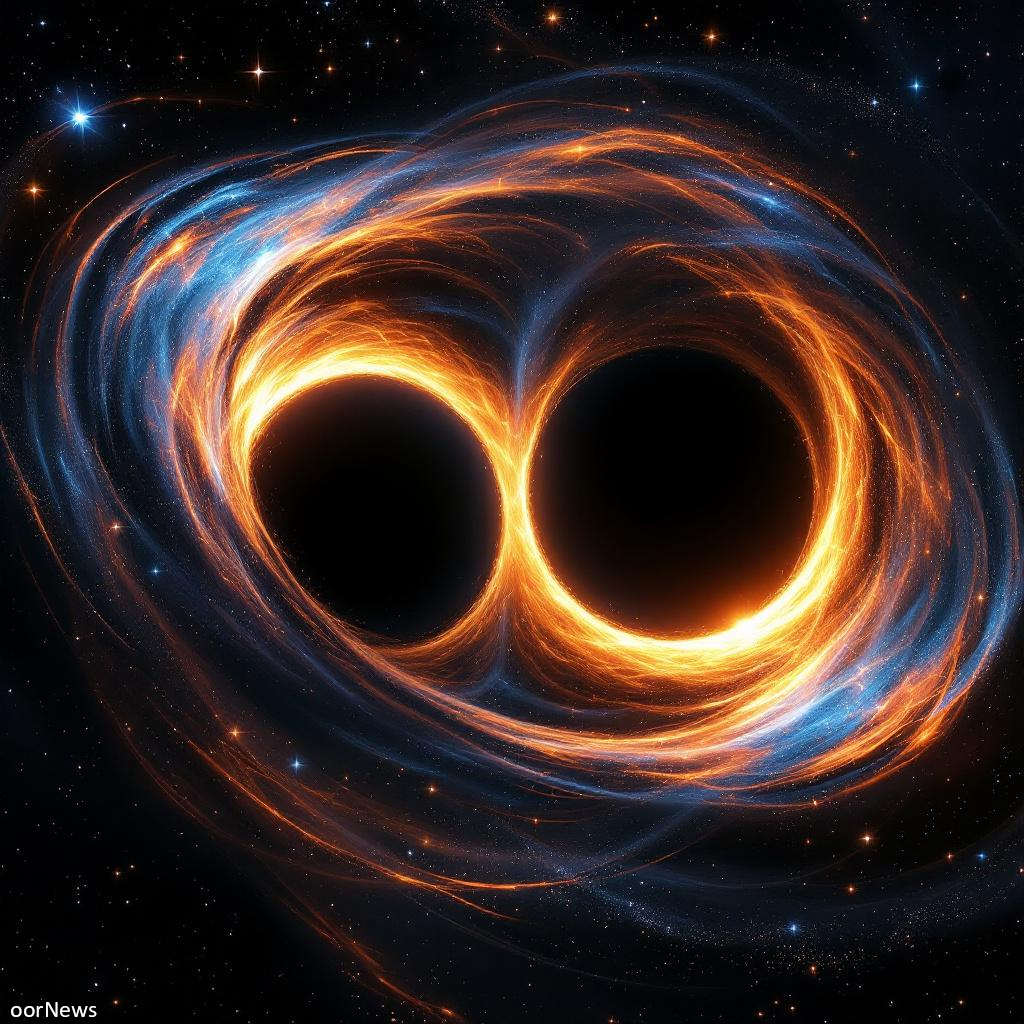
A record-breaking black hole collision has been spotted, revealing the largest black holes ever detected through gravitational waves. The event, coded GW231123, was observed on November 23, 2023, by the LIGO-Virgo-KAGRA collaboration using US-based LIGO observatories.
The final black hole formed weighs over 225 times the mass of our Sun. This unprecedented size challenges existing ideas about how black holes form. The two merging black holes measured about 100 and 140 solar masses, spinning rapidly and hinting at a complex past, possibly involving earlier mergers of smaller black holes.
University of Glasgow researchers played a key role in analysing the signal and fitting the data to models. Dr Daniel Williams, leading the data analysis team, noted, “This exciting event is one of many which we’ve analysed from data collected in 2023 and early 2024… it’s an excellent example of how we’re still discovering new and unexpected things about black holes and ultimately about how stars evolve.”
The findings will be shared at the GR-Amaldi meeting — the world’s largest conference on gravitational waves — taking place in Glasgow from July 14 to 18, 2025. This event comes as the scientific community approaches the 10th anniversary of the first ever gravitational wave detection.
Experts say it will take years to fully understand this complex signal and its meaning for cosmic history. For now, the discovery marks a significant step in gravitational wave astronomy, pushing technology and theories to new heights.