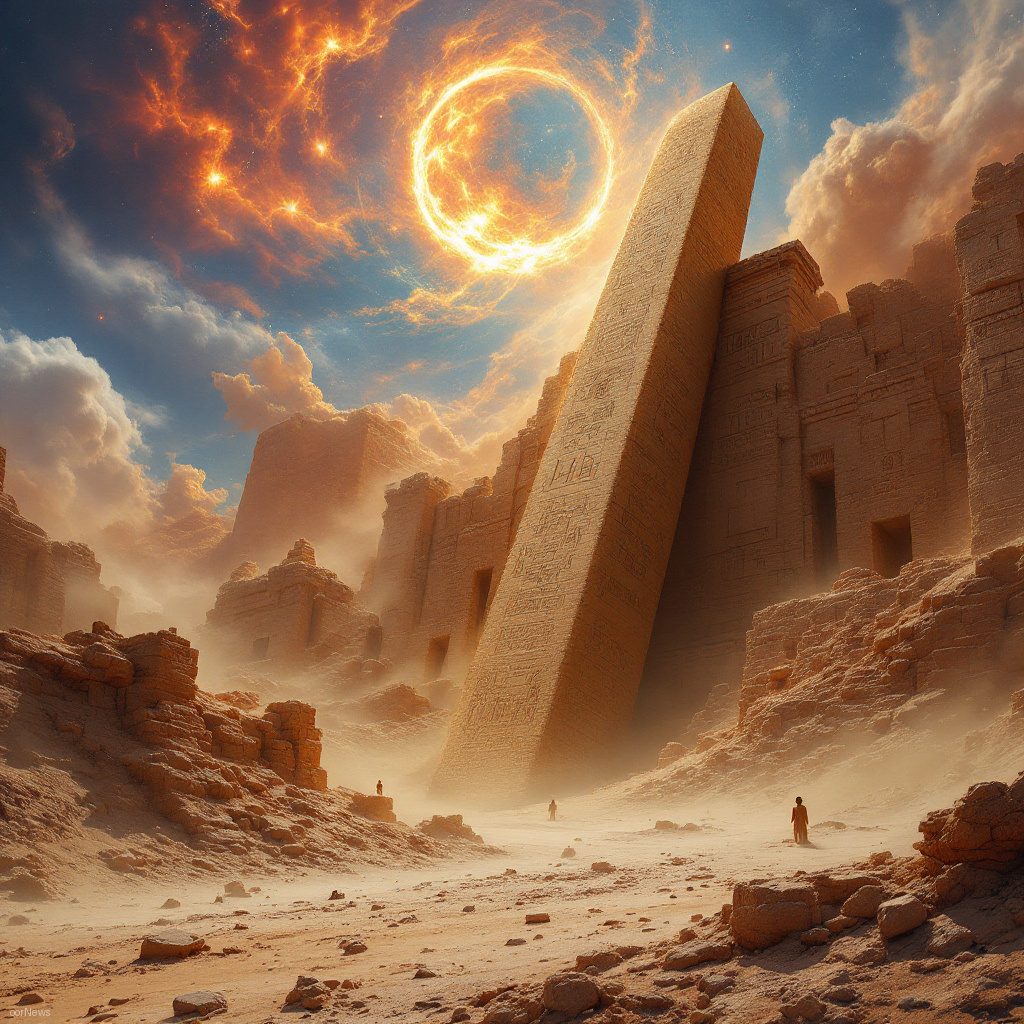
For decades, the sands of Egypt have concealed profound mysteries: the monumental scale of its megalithic structures, the sudden emergence of an advanced civilization, and the enigmatic concept of “Zep Tepi,” or “First Time,” referenced in ancient texts. Now, a groundbreaking hypothesis by researcher Catherine Ulissey (Schoch) is challenging conventional narratives, proposing that many of Egypt’s most iconic sites were not merely constructed but deliberately buried and preserved by a sophisticated prehistoric civilization in response to a catastrophic solar event.
Ulissey draws striking parallels between Egypt and the ancient Turkish site of Göbekli Tepe—a complex dated to around 9700 BCE and widely accepted as intentionally buried following a period of natural upheaval. “Göbekli Tepe shows us that ancient, advanced cultures did bury their treasures,” Ulissey asserts. “Why couldn’t the same have happened in Egypt?”
Mountains of Mud Brick: A Radical Reinterpretation
At the heart of Ulissey’s argument lies the pervasive presence of massive mud brick deposits and rubble at numerous Egyptian sites. Traditionally regarded as construction ramps or natural sedimentation from Nile floods, she offers a radical reinterpretation: these layers represent deliberate packing and preservation efforts. Envision Karnak not as a temple complex gradually built over centuries, but as a site once enveloped by colossal mud brick walls and mounds. Archival photographs from the late 1800s reveal clearing operations at Karnak that uncovered an obelisk dedicated to Hatshepsut, completely entombed beneath debris.
Similar patterns appear at the Hawara Pyramid, described by Ulissey as a “monstrous mountain of mud bricks covering megaliths,” as well as at the temples of Esna and Dendera. She argues these findings point to a coordinated effort to shield these sacred sites from an external cosmic threat.
Fingerprints of a Cosmic Cataclysm
Beyond archaeological reinterpretation, Ulissey, collaborating with her husband, geologist Dr. Robert M. Schoch, examines geological evidence for the solar event that might have prompted such monumental protective actions. Their research identifies a powerful solar outburst—or micronova—around 9700 BCE, coinciding with the end of the last ice age.
This theory is supported by hard scientific data. Sharp spikes in isotopes such as Beryllium-10 (^10Be) in ice cores and Carbon-14 (^14C) in tree rings have been documented worldwide. These isotopes form when intense cosmic rays—often unleashed during major solar storms—bombard Earth’s atmosphere, leaving a planetary fingerprint of ancient cataclysms. Notably, many of these isotope spikes align with geomagnetic excursions, or temporary “pole shifts,” suggesting that powerful solar events could weaken and destabilize Earth’s magnetic shield, exposing the planet to increased cosmic radiation.
This connection gains further credence from ancient rock art found globally, where intricate petroglyphs depict plasma-like shapes in the sky. Many researchers interpret these as eyewitness accounts of terrifying celestial phenomena linked to solar outbursts.
A Cycle of Catastrophe?
The implications extend far beyond ancient history. Today, Earth’s magnetic North Pole is shifting at an accelerated pace, and geologically, we approach the end of our current warm interglacial period—a transition historically marked by instability. This raises the sobering possibility that powerful solar-induced catastrophes may be recurring features of Earth’s natural cycles.
While the probability of another such event remains uncertain, Ulissey’s research underscores the dynamic and sometimes volatile relationship between our planet and cosmic forces. This emerging perspective invites us to reconsider ancient history and recognize that Earth’s past—and perhaps its future—has been shaped by powerful solar phenomena repeating over millennia.