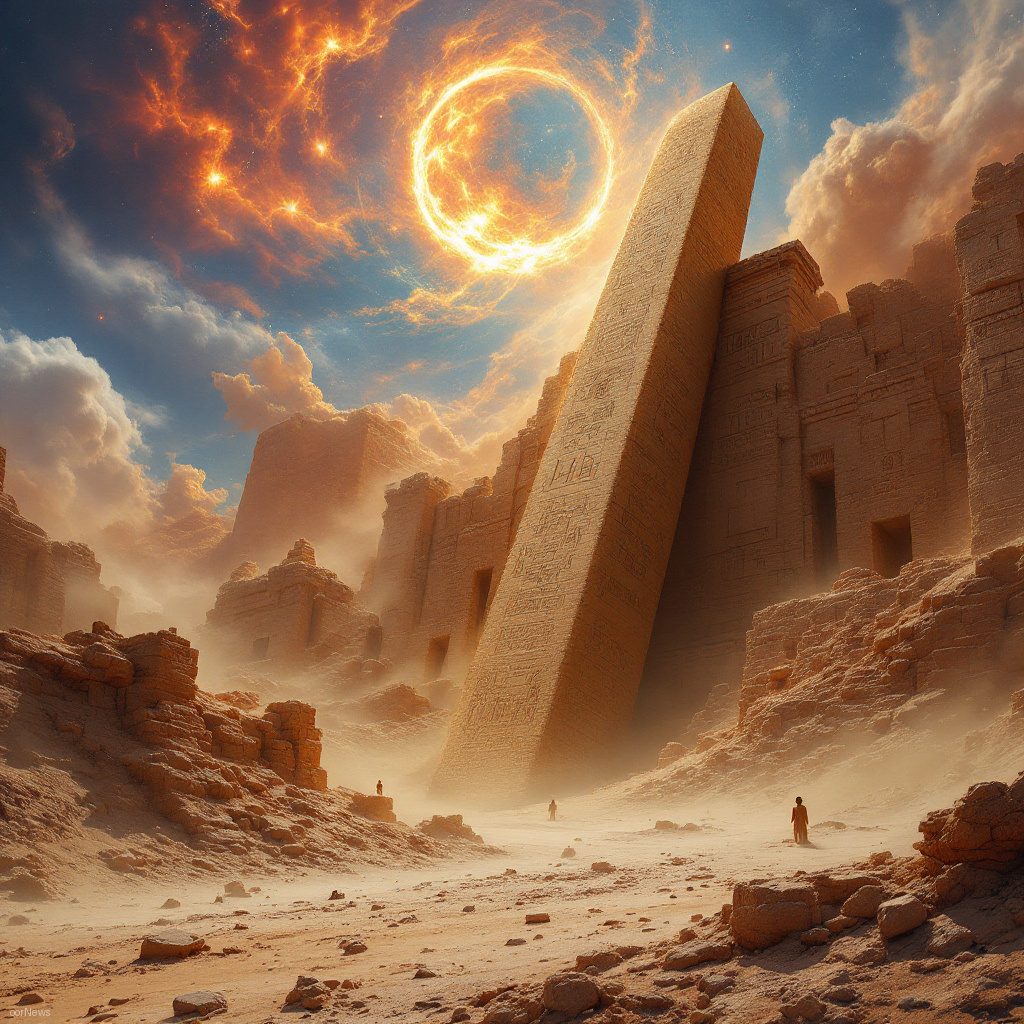
For decades, e sans o Egypt hae concealed profoon mysteries: e monumental scale o its megalithic structures, e sudden emergence o an advanced civilisation, an e enigmatic concept o “Zep Tepi,” or “First Time,” referenced in ancient texts. Noo, a grundbrakkin hypothesis by resaircher Catherine Ulissey (Schoch) is challengin conventional narratives, proposin aat mony o Egypt’s maist iconic sites wirna jist constructed but deliberately buried an preserved by a sophisticated prehistoric civilization in response til a catastrophic solar event.
Ulissey draas strickin parallels atween Egypt an e ancient Turkish site o Göbekli Tepe—a complex dated til aroon 9700 BCE an widely acceptit as intentionally buried follaein a period o natural upheaval. “Göbekli Tepe shaws us aat ancient, advanced cultures did bury thair treisurs,” Ulissey asserts. “Fit wey nae cuid e same hae happened in Egypt?”
Moontains o Dubs Brick: A Radical Reinterpretation
At e hert o Ulissey’s argument lies e pervasive presence o massive dubs brick deposits an ribble at numerous Egyptian sites. Traditionally regairded as construction ramps or naitural sedimentation fae Nile fluids, she offers a radical reinterpretation: iss layers represent deliberate packin an preservation efforts. Envision Karnak nae as a temple complex gradually biggit ower centuries, but as a site eence enveloped by colossal dubs brick waas an mounds. Archive photographs fae e late 1800s shaw clearin operations at Karnak aat unkivvered an obelisk dedicated tae Hatshepsut, completely entombed aneath debris.
Similar paitterns appear at e Hawara Pyramid, descreived by Ulissey as a “monstrous moontain o dubs bricks kivverin megaliths,” as weel as at e temples o Esna an Dendera. She argues iss finnins pynt til a coordinated effort tae beild iss sacred sites fae an external cosmic threit.
Fingerprints o a Cosmic Cataclysm
Ayont archaeological reinterpretation, Ulissey, collaboratin wi her guidman, geologist Dr. Robert M. Schoch, examines geological evidence for e solar event aat micht hae prompted sic monumental protective actions. Thair resairch identifies a pouerfu solar ootburst—or micronova—aroon 9700 BCE, coincidin wi e eyn o the last ice age.
Iss theory is supported by haird scientific data. Shairp spikes in isotopes sic as Beryllium-10 (^10Be) in ice cores an Carbon-14 (^14C) in tree rings hae bin documented warldwide. Iss isotopes form fan intense cosmic rays—aften unleashed durin major solar storms—bombard Earth’s atmosphere, leain a planetary fingerprint o ancient cataclysms. Notably, mony o iss isotope spikes align wi geomagnetic excursions, or temporary “pole shifts,” suggestin aat pouerfu solar events cuid weaken an destabilise Earth’s magnetic sheild, exposin e planet tae increased cosmic radiation.
Iss connection gains further credence fae ancient rock airt fund aa ower e warld, far intricate petroglyphs depict plasma-like shapes in e sky. Mony resairchers interpret iss as eewitness accounts o terrifyin celestial phenomena linked tae solar ootbursts.
A Cycle o Catastrophe?
E implications extend far ayont ancient history. E day, Yird’s magnetic Nor Pole is shiftin at an accelerated pace, an geologically, we approach e eyn o oor current waarm interglacial period—a transition historically merked by instability. Iss raises e soberin possibility aat pouerfu solar-induced catastrophes micht be recurrin features o Earth’s naitural cycles.
Fyles e probability o anither sic event bides uncertain, Ulissey’s resairch unnerscores e dynamic an sometimes volatile relationship atween oor planet an cosmic forces. Iss emergin perspective invites us tae reconsider ancient history an tak tent aat Earth’s past—an aiblins its future—his bin shaped by pouerfu solar phenomena repeatin ower millennia.